The current passing through the battery in the given circuit, is:

1. \(2.5~\text{A}\)
2. \(1.5~\text{A}\)
3. \(2.0~\text{A}\)
4. \(0.5~\text{A}\)


Subtopic: Wheatstone Bridge |
Level 3: 35%-60%
NEET - 2025
Please attempt this question first.
Hints
Please attempt this question first.

Three identical heat conducting rods are connected in series as shown in the figure. The rods on the sides have thermal conductivity \(2K\) while that in the middle has thermal conductivity \(K\). The left end of the combination is maintained at temperature \(3T\) and the right end at \(T.\) The rods are thermally insulated from outside. In the steady state, temperature at the left junction is \(T_1\) and that at the right junction is \(T_2\). The ratio \(\dfrac{T_1}{T_2}\) is:

| 1. | \(\dfrac{5}{3}\) | 2. | \(\dfrac{5}{4}\) |
| 3. | \(\dfrac{3}{2}\) | 4. | \(\dfrac{4}{3}\) |
Subtopic: Conduction |
Level 3: 35%-60%
NEET - 2025
Please attempt this question first.
Hints
Please attempt this question first.
In an oscillating spring mass system, a spring is connected to a box filled with the sand. As the box oscillates, sand leaks slowly out of the box vertically so that the average frequency \(\omega~(t)\) and average amplitude \(A~(t)\) of the system changes with time \(t.\) Which of the following options systemically depicts these changes correctly?
| 1. | 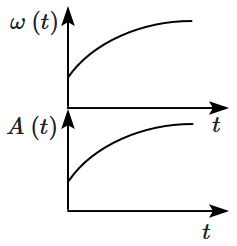 |
2. |  |
| 3. |  |
4. |  |
Subtopic: Spring mass system |
Level 3: 35%-60%
NEET - 2025
Please attempt this question first.
Hints
Please attempt this question first.


\(AB\) is a part of an electrical circuit (see figure). The potential difference \(''V_{A}-V_{B}'',\) at the instant when current \(i=2~\text A\) and is increasing at a rate of \(1~\text{amp/second}\) is:

| 1. | \(9~ \text{volts}\) | 2. | \(10~ \text{volts}\) |
| 3. | \(5~ \text{volts}\) | 4. | \(6~ \text{volts}\) |
Subtopic: LR circuit |
58%
Level 3: 35%-60%
NEET - 2025
Please attempt this question first.
Hints
Please attempt this question first.
A particle of mass \(m\) is moving around the origin with a constant force \(F\) pulling it towards the origin. If Bohr model is used to describe its motion, the radius \(r\) of the \(n^{\text{th}}\) orbit and the particle's speed \(v\) in the orbit depend on \(n\) as:
| 1. | \(r \propto n^{2/3}; v \propto n^{1/3}\) |
| 2. | \(r \propto n^{4/3}; v \propto n^{-1/3}\) |
| 3. | \(r \propto n^{1/3}; v \propto n^{1/3}\) |
| 4. | \(r \propto n^{1/3}; v \propto n^{2/3}\) |
Subtopic: Bohr's Model of Atom |
Level 3: 35%-60%
NEET - 2025
Please attempt this question first.
Hints
Please attempt this question first.
In some appropriate units, time \((t)\) and position \((x)\) relation of a moving particle is given by \(t=x^2+x. \) The acceleration of the particle is:
| 1. | \(+\dfrac{2}{(x+1)^3}\) | 2. | \(+\dfrac{2}{(2x+1)}\) |
| 3. | \(-\dfrac{2}{(x+2)^3}\) | 4. | \(-\dfrac{2}{(2x+1)^3}\) |
Subtopic: Non Uniform Acceleration |
Level 3: 35%-60%
NEET - 2025
Please attempt this question first.
Hints
Please attempt this question first.


A model for the quantized motion of an electron in a uniform magnetic field \(B\) states that the flux passing through the orbit of the electron is \(n(h/e)\) where \(n\) is an integer, \(h\) is Planck's constant and \(e\) is the magnitude of the electron's charge. According to the model, the magnetic moment of an electron is its lowest energy state will be (\(m\) is the mass of the electron):
| 1. | \(\dfrac{heB}{\pi m}\) | 2. | \(\dfrac{heB}{2\pi m}\) |
| 3. | \(\dfrac{he}{\pi m}\) | 4. | \(\dfrac{he}{2\pi m}\) |
Subtopic: Magnetic Moment |
Level 3: 35%-60%
NEET - 2025
Please attempt this question first.
Hints
Please attempt this question first.
A microscope has an objective of focal length \(2~\text{cm},\) eyepiece of focal length \(4~\text{cm}\) and the tube length of \(40~\text{cm}.\) If the distance of distinct vision of eye is \(25~\text{cm},\) the magnification in the microscope is:
| 1. | \(150\) | 2. | \(250\) |
| 3. | \(100\) | 4. | \(125\) |
Subtopic: Simple & Compound Microscope |
Level 3: 35%-60%
NEET - 2025
Please attempt this question first.
Hints
Please attempt this question first.
There are two inclined surfaces of equal length \((L)\) and same angle of inclination \(45^\circ\) with the horizontal. One of them is rough and the other is perfectly smooth. A given body takes \(2\) times as much time to slide down on rough surface than on the smooth surface. The coefficient of kinetic friction \((\mu_k)\) between the object and the rough surface is close to:
| 1. | \(0.5\) | 2. | \(0.75\) |
| 3. | \(0.25\) | 4. | \(0.40\) |
Subtopic: Friction |
58%
Level 3: 35%-60%
NEET - 2025
Please attempt this question first.
Hints
Please attempt this question first.


A full wave rectifier circuit with diodes \((D_1)\) and \((D_2)\) is shown in the figure. If input supply voltage \(V_{\text{in}}=220\sin(100\pi t)\) volt, then at \(t=15~\text{ms}\text{:}\)

| 1. | \(D_1\) and \(D_2\) both are forward biased |
| 2. | \(D_1\) and \(D_2\) both are reverse biased |
| 3. | \(D_1\) is forward biased, \(D_2\) is reverse biased |
| 4. | \(D_1\) is reverse biased, \(D_2\) is forward biased |
Subtopic: Rectifier |
Level 4: Below 35%
NEET - 2025
Please attempt this question first.
Hints
Please attempt this question first.

© 2025 GoodEd Technologies Pvt. Ltd.