
 Q. No.
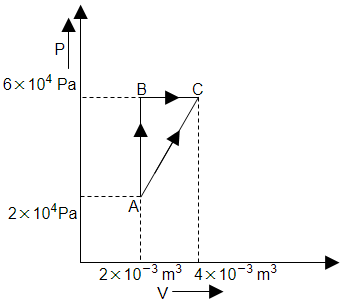
An ideal gas is taken through the process as shown in the figure. Then:

1.
In the process AB, the work done by the system is positive.
2.
In process AB, heat is rejected out of the system.
3.
In the process AB, internal energy increases.
4.
In the process AB, internal energy decreases, and in the process BC, internal energy increases.


An ideal gas is taken reversibly around the cycle \(a\text-b\text-c\text-d\text-a\) as shown on the temperature \((T)\) - entropy \((S)\) diagram.

The most appropriate representation of the above cycle on an internal energy \((U)\) - volume \((V)\) diagram is:
| 1. |  |
2. |  |
| 3. |  |
4. |  |
1 kg of gas does 20 kJ of work and receives 16 kJ of heat when it is expanded between two states. The second kind of expansion can be found between the same initial and final states, which requires a heat input of 9 kJ. The work done by the gas in the second expansion will be:
| 1. | 32 kJ | 2. | 5 kJ |
| 3. | -4 kJ | 4. | 13 kJ |


| 1. | \(Q_1=Q_2\) |
| 2. | \(W_1=W_2\) |
| 3. | \(Q_1-W_1=Q_2-W_2\) |
| 4. | \(Q_1+W_1=Q_2+W_2\) |
The figure below shows two paths that may be taken by a gas to go from state A to state C. In process AB, \(400~\text{J}\) of heat is added to the system and in process BC, \(100~\text{J}\) of heat is added to the system. The heat absorbed by the system in the process AC will be:
| 1. | \(380~\text{J}\) | 2. | \(500~\text{J}\) |
| 3. | \(460~\text{J}\) | 4. | \(300~\text{J}\) |
If ΔQ and ΔW represent the heat supplied to the system and
the work done on the system, respectively, then the first law of thermodynamics can be written as: (where ΔU is the internal energy)
1. ΔQ = ΔU + ΔW
2. ΔQ = ΔU – ΔW
3. ΔQ = ΔW – ΔU
4. ΔQ = –ΔU – ΔW


Can two isothermal curves cut each other?
| 1. | Never |
| 2. | Yes |
| 3. | They will cut when the temperature is 0°C. |
| 4. | Yes, when the pressure is equal to the critical pressure. |
The latent heat of vaporisation of water is \(2240~\text{J/gm}\). If the work done in the process of expansion of \(1~\text{g}\) is \(168~\text{J}\),
then the increase in internal energy is:
1. \(2408~\text{J}\)
2. \(2240~\text{J}\)
3. \(2072~\text{J}\)
4. \(1904~\text{J}\)
1. \(450~\text{K}\)
2. \(375~\text{K}\)
3. \(225~\text{K}\)
4. \(405~\text{K}\)


A polyatomic gas \(\left(\gamma = \frac{4}{3}\right)\) is compressed to \(\frac{1}{8}\) of its volume adiabatically. If its initial pressure is \(P_0,\) its new pressure will be:
| 1. | \(8P_0\) | 2. | \(16P_0\) |
| 3. | \(6P_0\) | 4. | \(2P_0\) |

© 2026 GoodEd Technologies Pvt. Ltd.