
 Q. No.
The QRS complex in a standard ECG represents:
1.
Depolarisation of auricles
2.
Depolarisation of ventricles
3.
Repolarisation of ventricles
4.
Repolarisation of auricles


Match the following columns and select the correct option:
| Column-I | Column-I | ||
| (a) | Eosinophils | (i) | Immune response |
| (b) | Basophils | (ii) | Phagocytosis |
| (c) | Neutrophils | (iii) | Acidophils |
| (d) | Lymphocytes | (iv) | Release granules containing histamine |
| (a) | (b) | (c) | (d) | |
| 1. | (iv) | (i) | (ii) | (iii) |
| 2. | (i) | (ii) | (iv) | (iii) |
| 3. | (ii) | (i) | (iii) | (iv) |
| 4. | (iii) | (iv) | (ii) | (i) |
Which of the following is associated with a decrease in cardiac output?
1. Sympathetic nerves
2. Parasympathetic neural signals
3. Pneumotaxic center
4. Adrenal medullary hormones


Which of the following conditions causes erythroblastosis fetalis?
| 1. | Mother and fetus |
| 2. | Mother and fetus |
| 3. | Both mother and fetus |
| 4. | Both mother and fetus |
The haemoglobin content per 100 ml of blood of a normal healthy human adult is:
| 1. | 25-30 g | 2. | 17-20g |
| 3. | 12-16 g | 4. | 5-11 |
Given below is the ECG of a normal human. Which one of its components is correctly interpreted below?
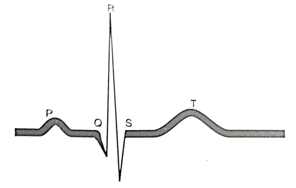
| 1. | Peak P-Initiation of left atrial contraction only |
| 2. | Complex QRS-One complete pulse |
| 3. | Peak T-Initiation of total cardiac contraction |
| 4. | Peak P and Peak R together-systolic and diastolic blood pressures |


The correct statement in respect of protein haemoglobin is that it:
| 1. | Maintains blood sugar level |
| 2. | Acts as an oxygen carrier in the blood |
| 3. | Forms antibodies and offers resistance to diseases |
| 4. | Functions as a catalyst for biological reactions |
Erythroblastosis fetalis is caused when:
| 1. | Rh– female & Rh+ male |
| 2. | Rh+ female & Rh– male |
| 3. | Rh+ female & Rh+ male |
| 4. | Rh– female & Rh– male |
Persons with 'AB' blood group are called as "Universal recipients". This is due to:
| 1. | Presence of antibodies, anti-A and anti-B, on RBCs. |
| 2. | Absence of antibodies, anti-A and anti-B, in plasma. |
| 3. | Absence of antigens A and B on the surface of RBCs. |
| 4. | Absence of antigens A and B in plasma. |


Which enzyme is responsible for the conversion of inactive fibrinogens to fibrins?
| 1. | Epinephrine | 2. | Thrombokinase |
| 3. | Thrombin | 4. | Renin |

© 2026 GoodEd Technologies Pvt. Ltd.