 Q. No.
| 1. | The production of seeds in the absence of pollination. |
| 2. | The formation of multiple embryos within a single ovule. |
| 3. | The development of fruits without fertilization, often induced by plant hormones. |
| 4. | The elongation of the ovary before fertilization. |


| 1. | Parthenocarpy refers to the development of flowers without pollination, and it is used in horticulture to enhance flowering in ornamental plants. |
| 2. | Parthenocarpy refers to the growth of seeds without fruits, and it is applied in horticulture to increase seed production in crops. |
| 3. | Parthenocarpy refers to the development of fruits without fertilization, and it is used in horticulture to produce seedless fruits like bananas and grapes. |
| 4. | Parthenocarpy refers to the fertilization of ovules without pollen, and it is used in horticulture to improve fruit size and quality. |
Match the following and choose the correct option:
| Column I | Column II | ||
| (a) | Aleurone layer | (i) | without fertilization |
| (b) | Parthenocarpic fruit | (ii) | Nutrition fruit |
| (c) | Ovule | (iii) | Double fertilization |
| (d) | Endosperm | (iv) | Seed |
Options:
| (a) | (b) | (c) | (d) | |
| 1. | (i) | (ii) | (iii) | (iv) |
| 2. | (ii) | (i) | (iv) | (iii) |
| 3. | (iv) | (ii) | (i) | (iii) |
| 4. | (ii) | (iv) | (i) | (iii) |


| Statement I: | Albuminous seeds retain a part of the endosperm in the mature seed. |
| Statement II: | Non-albuminous seeds completely lack endosperm in the mature seed because it is consumed during embryo development. |
| 1. | Statement I is correct; Statement II is correct. |
| 2. | Statement I is correct; Statement II is incorrect. |
| 3. | Statement I is incorrect; Statement II is correct. |
| 4. | Statement I is incorrect; Statement II is incorrect. |
| Type of Fruit | Description | ||
| A. | True fruits | 1. | Develop from the ovary of a flower. |
| B. | False fruits | 2. | Develop from parts other than the ovary. |
| C. | Parthenocarpic fruits | 3. | Develop without fertilization. |
2. A-1, B-3, C-2
3. A-3, B-1, C-2
4. A-1, B-2, C-3
Which one of the following in & generates new genetic combinations leading to variation?
1. Nucellar polyembryony
2. Vegetative reproduction
3. Parthenogenesis
4. Sexual reproduction


In a cereal grain the single cotyledon of the embryo is represented by
1. coleorhizae
2. scutellum
3. prophyll
4. coleoptiles
1. Plumule
2. Scutellum
3. Perisperm
4. Coleoptile
Given below a L.S. of an embryo of grass. Identify the labelled part (a), (b), (c) and (d) and select correct option about them :-
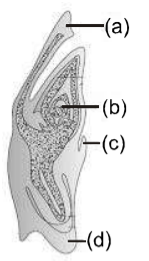
(a) (b) (c) (d)
1) Coleoptile Colerhiza Scutellum Shoot apex)
2) Scutellum Shoot apex Epiblast Coleorhiza
3) Radicle Root cap Scutellum Coleoptile
4) Root cap Scutellum Radicle Coleorhiza
1. 1
2. 2
3. 3
4. 4


| 1. | Protection against pests |
| 2. | Enhanced dispersal mechanisms |
| 3. | Better storage and survival during unfavorable conditions |
| 4. | Increased nutrient content in seeds |

© 2026 GoodEd Technologies Pvt. Ltd.