
 Q. No.
A spring has a spring constant \(k\). It is cut into two parts \(A\) and \(B\) whose lengths are in the ratio of \(m:1\). The spring constant of the part \(A\) will be:
1. \(\dfrac{k}{m}\)
2. \(\dfrac{k}{m+1}\)
3. \(k\)
4. \(\dfrac{k(m+1)}{m}\)
1. \(\dfrac{k}{m}\)
2. \(\dfrac{k}{m+1}\)
3. \(k\)
4. \(\dfrac{k(m+1)}{m}\)


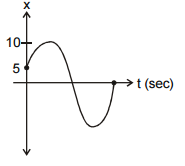
1. \(x= 10\sin\left(\pi t+\frac{\pi}{6}\right)\)
2. \(x= 10\sin\left(\pi t\right)\)
3. \(x= 10\cos\left(\pi t\right)\)
4. \(x= 5\sin\left(\pi t+\frac{\pi}{6}\right)\)
All the surfaces are smooth and the system, given below, is oscillating with an amplitude \({A}.\) What is the extension of spring having spring constant \({k_1},\) when the block is at the extreme position?

| 1. | \(\dfrac{k_1}{ k_1+k_2} A\) | 2. | \(\dfrac{k_2A}{k_1+k_2}\) |
| 3. | \(A\) | 4. | \(\dfrac{A}{2}\) |


| 1. | \(2v_0 \over \sqrt{3}\) | 2. | \(\sqrt{2}v_0 \over 3\) |
| 3. | \({2 \over 3}v_0\) | 4. | \(\sqrt{\frac{2}{3}}v_0\) |
In a simple harmonic oscillation, the graph of acceleration against displacement for one complete oscillation will be:
1. an ellipse
2. a circle
3. a parabola
4. a straight line
\(B\), it returns to \(B\) after another \(3~\text{s}\). The time period of the SHM will be:
| 1. | \(15~\text{s}\) | 2. | \(6~\text{s}\) |
| 3. | \(12~\text{s}\) | 4. | \(9~\text{s}\) |


Acceleration of the particle at \(t = \frac{8}{3}~\text{s}\) from the given displacement \((y)\) versus time \((t)\) graph will be?
1. \(\frac{\sqrt{3}\pi^2}{4}~\text{cm/s}^2\)
2. \(-\frac{\sqrt{3}\pi^2}{4}~\text{cm/s}^2\)
3. \(-\pi^2~\text{cm/s}^2\)
4. zero

| 1. | the gravity of the earth | 2. | the mass of the block |
| 3. | spring constant | 4. | both (2) & (3) |
A simple pendulum attached to the ceiling of a stationary lift has a time period of 1 s. The distance y covered by the lift moving downward varies with time as y = 3.75 , where y is in meters and t is in seconds. If g = 10 , then the time period of the pendulum will be:
| 1. | 4 s | 2. | 6 s |
| 3. | 2 s | 4. | 12 s |


The graph between the velocity \((v)\) of a particle executing SHM and its displacement \((x)\) is shown in the figure. The time period of oscillation for this SHM will be:
1. \(\sqrt{\frac{\alpha}{\beta}}\)
2. \(2\pi\sqrt{\frac{\alpha}{\beta}}\)
3. \(2\pi\left(\frac{\beta}{\alpha}\right)\)
4. \(2\pi\left(\frac{\alpha}{\beta}\right)\)


© 2026 GoodEd Technologies Pvt. Ltd.