
 Q. No.
The efficiency of a Carnot heat engine working between the temperatures \(27^{\circ}\mathrm{C}\) and \(227^{\circ}\mathrm{C}\) is:
1. 0.1
2. 0.6
3. 0.2
4. 0.4
1. 0.1
2. 0.6
3. 0.2
4. 0.4


The cyclic process of \(2\) moles of diatomic gas is shown in the figure. Which of the following statements is correct?

| 1. | The process \(BC\) is an isothermal compression. |
| 2. | The work done in the process \(CA\) is \(4 R T_0\) |
| 3. | The work done in the process \(AB\) is zero. |
| 4. | All of these |


An ideal gas is enclosed in an insulated cylinder. The piston is frictionless and attached to an ideal spring. When the gas is heated, then:

| 1. | the work is done against the spring only. |
| 2. | the work is done against the atmospheric pressure only. |
| 3. | the internal energy of gas increases. |
| 4. | the work is equal to the heat supplied. |
If a gas undergoes the change in its thermodynamic state from A to B via two different paths, as shown in the given pressure (P) versus volume (V) graph, then:

| 1. | the temperature of the gas decreases in path 1 from A to B. |
| 2. | the heat absorbed by the gas in path 1 is greater than in path 2. |
| 3. | the heat absorbed by the gas in path 2 is greater than in path 1. |
| 4. | the change in internal energy in path 1 is greater than in path 2. |

The PV diagram of an ideal gas is shown in the figure. The work done by the gas in the process is given by:

| 1. | \(\frac{9}{2}P_0V_0\) | 2. | \(\frac{15}{2}P_0V_0\) |
| 3. | \(\frac{13}{2}P_0V_0\) | 4. | \(\frac{3}{2}P_0V_0\) |


A pressure \((P)\) versus volume \((V)\) graph is obtained for an ideal gas from state \(A\) to state \(B\) (as shown in the figure below). Which of the following is the correct statement?

| 1. | The temperature of gas increases continuously. |
| 2. | The temperature of gas decreases continuously. |
| 3. | The temperature first increases, then decreases. |
| 4. | The temperature first decreases, then increases. |
When the sink temperature is kept at \(400~\text{K},\) the efficiency of a Carnot engine is \(50\text{%}.\) While keeping the source temperature constant, by how much should we reduce the sink temperature to increase the efficiency to \(60\text{%}\text{?}\)
| 1. | \(80\) K | 2. | \(70\) K |
| 3. | \(320\) K | 4. | \(240\) K |
Which of the following graph shows the variation of pressure P with volume V for an ideal gas at a constant temperature?
| 1. |  |
2. |  |
| 3. |  |
4. | 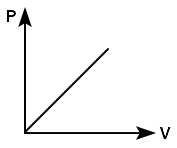 |


A gas performs the minimum work when it expands:
| 1. | Isochorically | 2. | Isobarically |
| 3. | Adiabatically | 4. | Isothermally |

© 2025 GoodEd Technologies Pvt. Ltd.