- 1(current)
 Q. No.
The testes are situated outside the abdominal cavity within a pouch called the scrotum. This is necessary as:
| 1. | The scrotum can contain lengthy ducts for the transfer of sperms |
| 2. | Scrotum helps in maintaining the low temperature of the testes necessary for spermatogenesis |
| 3. | Scrotum reduces the pressure around the testes necessary for spermatogenesis |
| 4. | Scrotum can store huge amounts of sperms |


Subtopic: Male Reproductive System | Basic Anatomy of Testis |
96%
Level 1: 80%+
Hints

Which of the following will not be a correct match for testes?
| 1. | Length | about 4 to 5 cm |
| 2. | Width | about 2 to 3 cm |
| 3. | Lobes | three in right and two in left |
| 4. | Temperature | 2–2.5°C lower than the normal internal body temperature |
Subtopic: Male Reproductive System | Basic Anatomy of Testis |
94%
Level 1: 80%+
Please attempt this question first.
Hints
Please attempt this question first.
Subtopic: Male Reproductive System |
88%
Level 1: 80%+
Hints


Leydig cells:
| 1. | Are present in seminiferous tubules and secrete androgens |
| 2. | Are present in seminiferous tubules and help in the maturation of sperms |
| 3. | Are present in interstitial space and secrete androgens |
| 4. | Are present in interstitial space and help in the maturation of sperms |
Subtopic: Male Reproductive System |
80%
Level 1: 80%+
Hints
What will be true for the parts labels A and B in the given diagram?

| I: | A is the longest male sex accessory duct and stores sperms. |
| II: | B is the only gland that does not contribute significantly to the composition of the seminal plasma. |
| 1. | Only I is correct | 2. | Only II is correct |
| 3. | Both I and II are correct | 4. | Both I and II are incorrect |
Subtopic: Male Reproductive System |
56%
Level 3: 35%-60%
Please attempt this question first.
Hints
Please attempt this question first.
Identify the part of the male reproductive system where sperms mature and gain capability of motility:
1. Epididymis
2. Vas deferens
3. Seminal vesicles
4. Prostate gland
1. Epididymis
2. Vas deferens
3. Seminal vesicles
4. Prostate gland
Subtopic: Male Reproductive System | Male Reproductive Duct System |
70%
Level 2: 60%+
Please attempt this question first.
Hints
Please attempt this question first.

Seminal plasma contains:
| I: | secretions of seminal vesicles, prostate and bulbo-urethral glands. |
| II: | sperms |
| 1. | Only I | 2. | Only II |
| 3. | Both I and II | 4. | Neither I nor II |
Subtopic: Male Reproductive System |
Level 3: 35%-60%
Please attempt this question first.
Hints
Please attempt this question first.
Identify A, B, C and D in the given diagram:
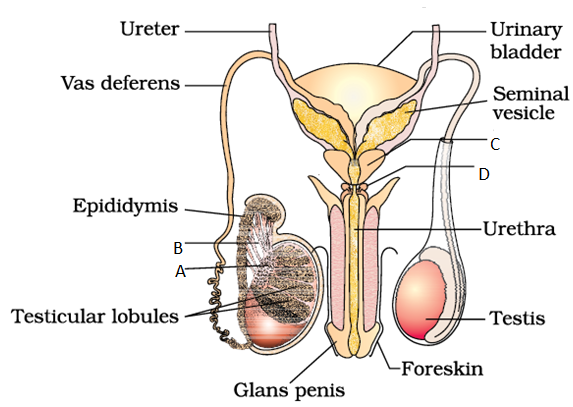
| A | B | C | D | |
| 1. | Seminiferous tubule | Rete testes | Prostate | Bulbourethral gland |
| 2. | Rete testes | Vasa efferentia | Prostate | Bulbourethral gland |
| 3. | Rete testes | Vasa efferentia | Bulbourethral gland | Prostate |
| 4. | Seminiferous tubule | Rete testes | Bulbourethral gland | Prostate |
Subtopic: Male Reproductive System | Basic Anatomy of Testis |
73%
Level 2: 60%+
Please attempt this question first.
Hints
Please attempt this question first.
What is the urethral meatus?
| 1. | The point of entry of urethra into the prostate gland |
| 2. | Opening of ejaculatory duct into urethra |
| 3. | External opening of the urethra |
| 4. | Muscles surrounding the urethra |
Subtopic: Male Reproductive System |
87%
Level 1: 80%+
Please attempt this question first.
Hints
Please attempt this question first.

Which of the following cells will have two sets of chromosomes?
a. Primary spermatocyte
b. Spermatogonia
c. First polar body
d. Second polar body
1. Only a and b
2. Only c and d
3. Only a and c
4. Only b and d
a. Primary spermatocyte
b. Spermatogonia
c. First polar body
d. Second polar body
1. Only a and b
2. Only c and d
3. Only a and c
4. Only b and d
Subtopic: Male Reproductive System | Basic Anatomy of Testis | Seminiferous Tubules & Spermatogenesis | Spermiogenesis/Sperm Structure/Hormonal Regulation |
85%
Level 1: 80%+
Please attempt this question first.
Hints
Please attempt this question first.
- 1(current)
Q. No.
© 2026 GoodEd Technologies Pvt. Ltd.