 Q. No.
An ideal gas undergoes a cyclic process ABCA as shown. The heat exchange between the system and the surrounding during the process will be:
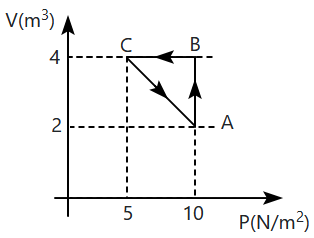
| 1. | 10 J | 2. | 5 J |
| 3. | 15 J | 4. | 20 J |


A thermodynamic system undergoes a cyclic process \(ABCDA\) as shown in Fig. The work done by the system in the cycle is:
1. \( P_0 V_0 \)
2. \( 2 P_0 V_0 \)
3. \( \frac{P_0 V_0}{2} \)
4. zero




In the cyclic process shown in the pressure-volume \((P-V)\) diagram, the change in internal energy is equal to:

1.
2.
3.
4. zero
Which one of the following is correct for one complete cycle of a thermodynamic process on a gas as shown in the \((P-V)\) diagram?

| 1. | \(\Delta E_{int}= 0, Q<0\) | 2. | \(\Delta E_{int}= 0, Q>0\) |
| 3. | \(\Delta E_{int}>0, Q<0\) | 4. | \(\Delta E_{int}< 0, Q>0\) |
An ideal gas is taken through the cycle \(A\rightarrow B\rightarrow C\rightarrow A\) as shown in the figure below. If the net heat supplied to the gas is \(10~\text{J}\), then the work done by the gas in the process \(B\rightarrow C\) is:

| 1. | \(-10~\text{J}\) | 2. | \(-30~\text{J}\) |
| 3. | \(-15~\text{J}\) | 4. | \(-20~\text{J}\) |


For the indicator diagram given below, which of the following is not correct?

| 1. | Cycle II is a heat engine cycle. |
| 2. | Net work is done on the gas in cycle I. |
| 3. | Work done is positive for cycle I. |
| 4. | Work done is positive for cycle II. |

In the \((P\text-V)\) diagram shown, the gas does \(5~\text J\) of work in the isothermal process \(ab\) and \(4~\text J\) in the adiabatic process \(bc.\) What will be the change in internal energy of the gas in the straight path from \(c\) to \(a?\)

1. \(9~\text J\)
2. \(1~\text J\)
3. \(4~\text J\)
4. \(5~\text J\)
In a cyclic process, the internal energy of the gas:
| 1. | increases | 2. | decreases |
| 3. | remains constant | 4. | becomes zero |


If in the thermodynamic process shown in the figure, the work done by the system along A B C is 50 J and the change in internal energy during C A is 30 J, then the heat supplied during A B C is:

| 1. | 50 J | 2. | 20 J |
| 3. | 10 J | 4. | 80 J |

© 2025 GoodEd Technologies Pvt. Ltd.