- 1(current)
 Q. No.
Two stones are thrown simultaneously from the edge of a cliff \(240~\text{m}\) high. The first stone is thrown upward with an initial speed of \(10~\text{m/s},\) and the second with \(40~\text{m/s}.\) Assuming the stones do not bounce after hitting the ground and neglecting air resistance (\(g= 10~\text{m/s}^2\)), which of the following graphs best represents how the position of the second stone varies relative to the first stone with time? (graphs are schematic and not drawn to scale)
| 1. | 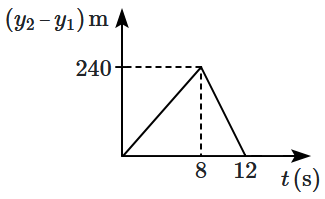 |
| 2. | 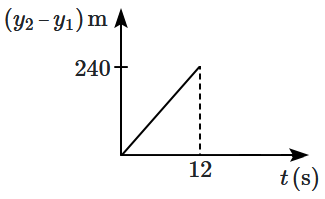 |
| 3. | 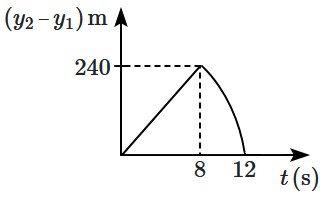 |
| 4. | 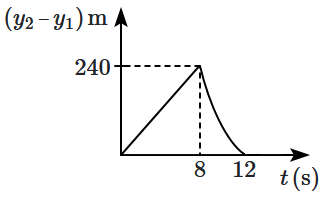 |


1. \(\sqrt{120}~\text{s} \)
2. \(15~\text{s}\)
3. \(10\sqrt2~\text{s} \)
4. \(\sqrt{110}~\text{s} \)
Train \(\mathrm{A}\) and Train \(\mathrm{B}\) are running on parallel tracks in opposite directions with speeds of \(36~\text{km/h}\) and \(72~\text{km/h},\) respectively. A person is walking inside Train \(\mathrm{A}\) in the direction opposite to the train's motion with a speed of \(1.8~\text{km/h} .\) What is the speed of this person as observed from Train \(\mathrm{B}\)? (Assume the distance between the tracks is negligible.)
| 1. | \(30.5\) m/s | 2. | \(29.5\) m/s |
| 3. | \(31.5\) m/s | 4. | \(28.5\) m/s |


1. 100 m
2. 200 m
3. 300 m
4. 400 m
- 1(current)
Q. No.
© 2025 GoodEd Technologies Pvt. Ltd.