 Q. No.
Given below is the structure of sperm of the human male
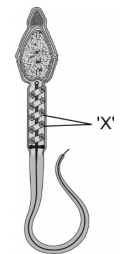
Identify the structure ‘X’ and choose the option representing the correct description/function of X.
1. Contains chromosomal material
2. Provides energy source for swimming
3. Contains enzyme that helps in fertilization of the ovum
4. Secretes hormone for maturation and its motility


Acrosome is
(1) Part of sperm head
(2) Caps the anterior portion of haploid nucleus
(3) Has enzymes for fertilization
(4) All of these
Which of the following cell will undergo meiosis?
1. Sertoli cells
2. Spermatogonia
3. Leydig cell
4. Immunologically competent cells


The correct sequence of spermatogenetic stages leading to the formation of sperms in a mature human testis is
| 1. | spermatocyte - spermatogonia - spermatid - sperms |
| 2. | spermatogonia - spermatocyte - spermatid -sperms |
| 3. | spermatid-spermatocyte-spermatogonia -sperms |
| 4. | spermatogonia-spermatid-spermatocyte -sperms |
Which of the following does not has 46 chromosomes?
| 1. | Spermatogonia | 2. | Primary Spermatocyte |
| 3. | Spermatozoa | 4. | Sertoli cells |
Which of the following depicts the correct pathway of transport of sperms?
| 1. | Rete testis →Efferent ductules → Epididymis → vas deferens |
| 2. | Rete testis → Epididymis → Efferent ductules → vas deference |
| 3. | Rete testis → Vas deference → Efferent ductules → Epididymis |
| 4. | Efferent ductules →Rete testis → Vas deference →Epididymis |


The final release of sperms from the seminiferous tubules is called:
1. Spermiation
2. Emission
3. Retrograde ejaculation
4. Ejaculation
Spermiation is
| 1. | Release of sperms from seminiferous tubules |
| 2. | Release of secondary spermatocyte from seminiferous tubules |
| 3. | Release of spermatids from seminiferous tubules |
| 4. | Release of spermatogenic from seminiferous tubules |
| 1. | In spermiogenesis, spermatids are formed, while in spermiation, spermatozoa are formed. |
| 2. | In spermiogenesis, spermatozoa are formed, while in spermiation, spermatids are formed. |
| 3. | In spermiogenesis, spermatozoa from Sertoli cells are released into the cavity of seminiferous tubules, while in spermiation, spermatozoa are formed. |
| 4. | In spermiogenesis, spermatozoa are formed, while in spermiation, spermatozoa are released from Sertoli cells into the cavity of seminiferous tubules. |


The spermatids are transformed into spermatozoa by the process called:
1. Spermiation
2. Spermatocytogenesis
3. Spermiogenesis
4. Spermatolysis

© 2025 GoodEd Technologies Pvt. Ltd.