
 Q. No.
The rate constant for a first-order reaction is . The time required to reduce the initial concentration of the reactant to its 1/16 value is-
1.
2.
3.
4.


A first-order reaction's 10 percent completion time at 298 K is the same as its 25 percent completion time at 308 K. The value of will be:
1.
2.
3.
4.
A first-order reaction takes 40 min for 30% decomposition. Half life of the reaction is-
1. 55.9 min
2. 77.9 min
3. 63.9 min
4. 80.9 min


If the concentration of the reactant is made twice, the new rate of reaction for the second order reaction would be-
1. 2 times
2. 4 times
3. 3 times
4. No change in the rate of the reaction
Consider the following rate expression.
The order of reaction and dimension of the rate constant are, respectively-
1. ; k =
2. 3; k =
3. ; k =
4. ; k =
What are the dimensions of the rate constant K in the rate law \(\text { Rate }=k\left[H_2 O_2\right]\left[I^{-}\right]\)?
| 1. | 2. | ||
| 3. | 4. |


What is the ratio of the time required for 99% completion to the time required for
90% completion of a first-order reaction?
| 1. | 2. | ||
| 3. | 4. |
For the reaction 2A + B → A₂B, the rate law is rate = k[A][B]², where k = 2.0 × 10⁻⁶ mol⁻² L² s⁻¹,
[A] = 0.1 M, and [B] = 0.2 M. What is the initial rate of the reaction?
1. 0.04 mol
2. 8
3. 8
4. 8 mol
For the decomposition of azoisopropane to hexane and nitrogen at 543 K, the following data was obtained:
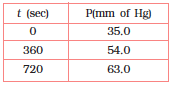
The rate constant of the above reaction would be -
| 1. | 1.21 × 10⁻³ s–1 | 2. | 2.21 × 10⁻³ s–1 |
| 3. | 3.21 × 10⁻³ s–1 | 4. | 4.21 × 10⁻³ s–1 |


During a nuclear explosion, one of the products is 90Sr with a half-life of 28.1 years. If 1µg of 90Sr was absorbed in the bones of a newly born baby instead of calcium, the amount of 90Sr that will remain after 10 years in the now grown up child would be -
(Given ,antilog(0.108)=1.28)
1. 0.227 µg
2. 0.781 µg
3. 7.81 µg
4. 2.27 µg

© 2026 GoodEd Technologies Pvt. Ltd.