
 Q. No.
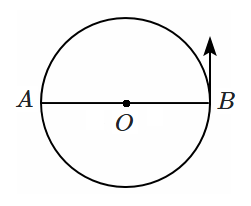
If a particle moves in a circle with a constant angular speed \((\omega)\) about the point \(O,\) then its angular speed about the point \(A\) will be:
1. \(2\omega\)
2. \(\dfrac{\omega}{2}\)
3. \(\omega\)
4. \(\dfrac{\omega}{4}\)
1. \(2\omega\)
2. \(\dfrac{\omega}{2}\)
3. \(\omega\)
4. \(\dfrac{\omega}{4}\)


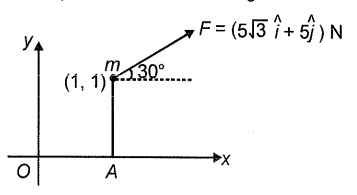
Which of the following is the value of the torque of force \(F\) about origin \(O:\)
1. \(\vec{\tau}=5(1-\sqrt{3}) \hat{k}\) N-m
2. \(\vec{\tau}=5(1-\sqrt{3}) \hat{j}\) N-m
3. \(\vec{\tau}=5(\sqrt{3}-1) \hat{i}\) N-m
4. \(\vec{\tau}=\sqrt{3} \hat{j}\) N-m

1. \(\frac{5}{3}mL^2\)
2. \(4mL^2\)
3. \(\frac{1}{4}mL^2\)
4. \(\frac{2}{3}mL^2\)


1. \(\vec{\tau}=(-17 \hat{\mathrm{i}}+6 \hat{\mathrm{j}}+4 \widehat{\mathrm{k}})\) N-m
2. \(\vec{\tau}=(-17 \hat{\mathrm{i}}+6 \hat{\mathrm{j}}-4 \widehat{\mathrm{k}}) \) N-m
3. \(\vec{\tau}=(17 \hat{\mathrm{i}}-6 \hat{\mathrm{j}}+4 \widehat{\mathrm{k}})\) N-m
4. \(\vec{\tau}=(-41 \hat{\mathrm{i}}+6 \hat{\mathrm{j}}+16 \hat{\mathrm{k}})\) N-m
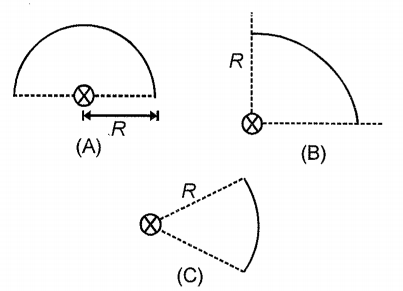
In the three figures, each wire has a mass M, radius R and a uniform mass distribution. If they form part of a circle of radius R, then about an axis perpendicular to the plane and passing through the centre (shown by crosses), their moment of inertia is in the order:
1.
2.
3.
4.
| 1. | \(1\) rad/s | 2. | \(2\) rad/s |
| 3. | \(3\) rad/s | 4. | \(4\) rad/s |


The value of \(M\), as shown, for which the rod will be in equilibrium is:

| 1. | \(1\) kg | 2. | \(2\) kg |
| 3. | \(4\) kg | 4. | \(6\) kg |
Particles \(A\) and \(B\) are separated by \(10~\text m,\) as shown in the figure. If \(A\) is at rest and \(B\) started moving with a speed of \(20~\text{m/s}\) then the angular velocity of \(B\) with respect to \(A\) at that instant is:

| 1. | \(1~\text{rad/s}\) | 2. | \(1.5~\text{rad/s}\) |
| 3. | \(2~\text{rad/s}\) | 4. | \(2.5~\text{rad/s}\) |
A uniform cubical block of side L rests on a rough horizontal surface with coefficient of friction . A horizontal force F is applied on the block as shown. If there is sufficient friction between the block and the ground, then the torque due to normal reaction about its centre of mass is:

1.
2.
3.
4.


A bomb is projected from the ground at a horizontal range of \(R\). If the bomb explodes mid-air, then the range of its centre of mass is:
1. \(\frac{R}{2}\)
2. \(R\)
3. \(2R\)
4. \(\frac{2R}{3}\)

© 2026 GoodEd Technologies Pvt. Ltd.