
 Q. No.
| 1. | zero velocity. | 2. | zero acceleration. |
| 3. | non-zero velocity. | 4. | non-zero acceleration. |


If a particle is moving along a straight line with increasing speed, then:
| 1. | its acceleration is negative. |
| 2. | its acceleration may be decreasing. |
| 3. | its acceleration is positive. |
| 4. | both (2) & (3) |
When the velocity of a body is variable, then:
| 1. | its speed may be constant |
| 2. | its acceleration may be constant |
| 3. | its average acceleration may be constant |
| 4. | all of the above |


A particle moves with velocity \(v_1\) for time \(t_1\) and \(v_2\) for time \(t_2\) along a straight line. The magnitude of its average acceleration is:
1.
2.
3.
4.
A body is projected vertically in the upward direction from the surface of the earth. If the upward direction is taken as positive, then the acceleration of the body during its upward and downward journey is:
| 1. | Positive, negative | 2. | Negative, negative |
| 3. | Positive, positive | 4. | Negative, positive |
A car travelling at a speed of \(30\) km/h is brought to rest at a distance of \(8\) m by applying brakes. If the same car is moving at a speed of \(60\) km/h, then it can be brought to rest with the same brakes in:
1. \(64\) m
2. \(32\) m
3. \(16\) m
4. \(4\) m


A balloon starts from the ground from rest with an upward acceleration of \(2\) m/s2. After \(1\) sec, a stone is dropped from it. The time taken by the stone to strike the ground is approximately:
| 1. | \(0.3\) s | 2. | \(0.7\) s |
| 3. | \(1\) s | 4. | \(1.4\) s |
Two balls are projected upward simultaneously with speeds of \(40\) m/s and \(60\) m/s. The relative position \((x)\) of the second ball with respect to the first ball at time \(t=5\) s will be: (neglect air resistance)
1. \(20\) m
2. \(80\) m
3. \(100\) m
4. \(120\) m
Which one of the following displacement-time graph represents two moving objects \(P\) and \(Q\) with zero relative velocity?
| 1. | 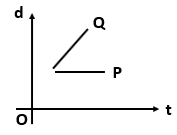 |
2. | 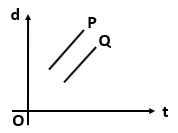 |
| 3. | 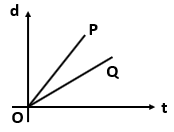 |
4. | 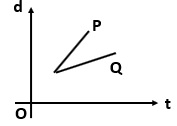 |


Two trains each of length \(100\) m are moving parallel towards each other at speeds \(72\) km/h and \(36\) km/h respectively. In how much time will they cross each other?
1. \(4.5~\text{s}\)
2. \(6.67~\text{s}\)
3. \(3.5~\text{s}\)
4. \(7.25~\text{s}\)

© 2026 GoodEd Technologies Pvt. Ltd.