
 Q. No.
A square of side a lies in the \(xy\)-plane, with two of its adjacent sides coinciding with the positive \(x\) and \(y\)-axes. The square therefore occupies the region \(0 \leq x \leq a,\quad 0 \leq y \leq a.\) If the square is placed in the non-uniform electric field \(\vec{E} = E_0 x\,\hat{k},\) where \(E_0\) is a constant, the electric flux through the square is:
1. \(E_0a^3\)
2. \(\dfrac{E_0a^3}{2}\)
3. \(\dfrac{E_0a^3}{3}\)
4. \(0\)

Sorry!! currently, the explanation for the question is not provided. If you need further help, please email at support@neetprep.com with subject: Explanation Missing for Question Id: 159855
Sorry!! currently, the explanation for the question is not provided. If you need further help, please email at support@neetprep.com with subject: Explanation Missing for Question Id: 159855

The electric field intensity which would be just sufficient to balance the weight of a particle of charge -10 and mass 10 mg, is
(Take \(g=10~\text{m/s}^2\))
1. 10 N/C, in an upward direction
2. N/C, in a downward direction
3. 10 N/C, in a downward direction
4. N/C, in an upward direction
Two charges are placed at a certain distance apart in the air. If a glass slab is introduced between them, then the force between the two charges will
1. Become zero
2. Decrease
3. Increase
4. Remain the same


A particle of mass m and charge q is placed at rest in a uniform electric field E and then released. The kinetic energy attained by the particle after moving a distance y is
1.
2.
3.
4.
Force of interaction between two bodies of the same nature of the charge
1. Must be repulsive
2. May be attractive
3. Must be attractive
4. Zero
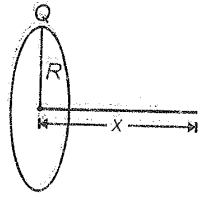
On the axis of a uniformly charged ring of radius R, as shown, the electric field is maximum at
1. x = 0
2.
3.
4.


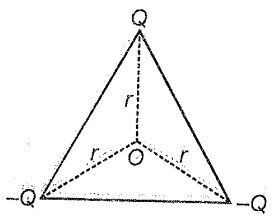
At the three corners of an equilateral triangle, charges are placed as shown in the figure. The magnitude of the electric field at point O is
1.
2.
3.
4.
Two symmetrical parallel metal each of one side plate area A having charges are placed at small separation. What will be the electric field at a point in between the plates?
1.
2.
3.
4.
An electric dipole of the moment is released in a uniform electric field from the position of maximum torque. The angular speed of the dipole when becomes parallel to will be [l = moment of inertia of dipole]
1.
2.
3.
4.


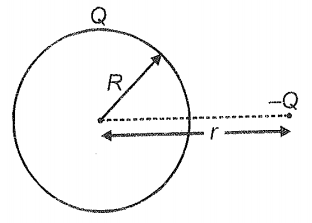
A charge Q is given to a conducting sphere of radius R. Now if a charge -Q is placed, as shown, at a distance r from the center, then the magnitude of the force of attraction between charges is
1.
2. <
3. >
4.

© 2026 GoodEd Technologies Pvt. Ltd.