
 Q. No.
Two metal spheres, one of radius \(R\) and the other of radius \(2R\) respectively have the same surface charge density \(\sigma.\) They are brought in contact and separated. What will be the new surface charge densities on them?
1.
\(\sigma_{1}=\dfrac{5}{6}\sigma ,~\sigma_{2}=\dfrac{5}{6}\sigma\)
2.
\(\sigma_{1}=\dfrac{5}{2}\sigma ,~\sigma_{2}=\dfrac{5}{6}\sigma\)
3.
\(\sigma_{1}=\dfrac{5}{2}\sigma ,~\sigma_{2}=\dfrac{5}{3}\sigma\)
4.
\(\sigma_{1}=\dfrac{5}{3}\sigma ,~\sigma_{2}=\dfrac{5}{6}\sigma\)


Two identical capacitors \(C_{1}\) and \(C_{2}\) of equal capacitance are connected as shown in the circuit. Terminals \(a\) and \(b\) of the key \(k\) are connected to charge capacitor \(C_{1}\) using a battery of emf \(V\) volt. Now disconnecting \(a\) and \(b\) terminals, terminals \(b\) and \(c\) are connected. Due to this, what will be the percentage loss of energy?
1. \(75\%\)
2. \(0\%\)
3. \(50\%\)
4. \(25\%\)

The electric potential \(V\) is given as a function of \(x\) (in metre) as \(V=(x^2-6x+5)\) volt The electric field is zero at:
| 1. | \(x=1~\text{m}\) | 2. | \(x=2~\text{m}\) |
| 3. | \(x=3~\text{m}\) | 4. | \(x=6~\text{m}\) |


If n identical drops, each of capacitance C, coalesce to form a single big drop, the capacitance of the big drop will be
1.
2. nC
3.
4.
An electric field is given by \(\vec E=(\hat i+2\hat j+\hat k)\) N/C. The work done in moving a \(1\) C charge from \(\vec {r_A}=(2\hat i+2\hat j)\) m to \(\vec {r_B}=(4\hat i+\hat j)\) m is:
1. \(8\) J
2. \(4\) J
3. \(-4\) J
4. zero
Which of the following is incorrect about the electrostatic field lines?
1. These can be never be closed curves
2. On a conducting surface, the lines are perpendicular
3. They can pass through a conductor
4. If the lines are equispaced and parallel to one another, then the field is uniform



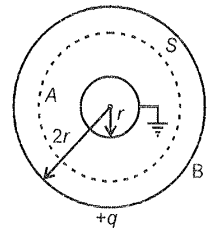
The conducting shells A and B are arranged as shown below. If the charge on the shell B is q then electric flux linked with the spherical Gaussian surface S is
1.
2.
3.
4.
A particle of mass 2 g and charge 1 is held at a distance of 1 m from a fixed charge of 1 mC. If the particle is released then its speed, when it is at a distance of 10 m from the fixed charge, is
1. 55 m/s
2. 100 m/s
3. 45 m/s
4. 90 m/s
The insulation property of air breaks down at \(E = 3\times 10^{6}~\text{V/m}\). The maximum charge that can be given to a sphere of diameter \(5\) m is approximately:
1. \(2\times 10^{-5}~\text{C}\)
2. \(2\times 10^{-4}~\text{C}\)
3. \(2\times 10^{-3}~\text{C}\)
4. \(3\times 10^{-3}~\text{C}\)


Given below are two statements:
| Statement I: | A sensitive electrical device can be protected from an external electric field by enclosing it within a metallic shell. |
| Statement II: | The electric field inside a metallic shell is zero, provided the shell does not contain any charge within it. |
| 1. | Statement I is correct and Statement II is incorrect. |
| 2. | Statement I is incorrect and Statement II is correct. |
| 3. | Both Statement I and Statement II are correct. |
| 4. | Both Statement I and Statement II are incorrect. |

© 2026 GoodEd Technologies Pvt. Ltd.