 Electrostatic Potential & Capacitance: (Electric Potential & Potential Energy)Contact Number: 8527521718Electrostatic Potential & Capacitance: (Electric Potential & Potential Energy)Contact Number: 8527521718
If a conductor has a potential V 0 and there are no charges anywhere else outside, then
(a) there must be charges on the surface or inside itself
(b) there cannot be any charge in the body of the conductor
(c) there must be charges only on the surface
(d) there must be charges inside the surface
(1) (a, c)
(2) (a, d)
(3) (a, b)
(4) (c, d)
Charges +q and –q are placed at points A and B, respectively; which are at a distance 2L apart. C is the midpoint between A and B. The work done in moving a charge +Q along the semicircle CRD is:
1.
2.
3.
4.
| 1. | \(9 \times 10^{-3}~\text{J}\) | 2. | \(9 \times 10^{-3}~\text{eV}\) |
| 3. | \(2~\text{eV/m}\) | 4. | zero |
| 1. | \(0.6\) m/s | 2. | \(6\) m/s |
| 3. | \(2\) m/s | 4. | \(4\) m/s |
An elementary particle of mass m and charge e is projected with velocity v at a much more massive particle of charge Ze, where . What is the closest possible approach of the incident particle ?
1.
2.
3.
4.
Three charges \(Q\), \(+q \) and \(+q \) are placed at the vertices of an equilateral triangle of side \(l\) as shown in the figure. If the net electrostatic energy of the system is zero, then \(Q\) is equal to:

| 1. | \(-\frac{q}{2} \) | 2. | \(-q\) |
| 3. | \(+q\) | 4. | \(\text{zero}\) |
| 1. |  |
2. |  |
| 3. |  |
4. |  |
| 1. | \(\sigma_{1}=\dfrac{5}{6}\sigma ,~\sigma_{2}=\dfrac{5}{6}\sigma\) |
| 2. | \(\sigma_{1}=\dfrac{5}{2}\sigma ,~\sigma_{2}=\dfrac{5}{6}\sigma\) |
| 3. | \(\sigma_{1}=\dfrac{5}{2}\sigma ,~\sigma_{2}=\dfrac{5}{3}\sigma\) |
| 4. | \(\sigma_{1}=\dfrac{5}{3}\sigma ,~\sigma_{2}=\dfrac{5}{6}\sigma\) |
| 1. | \(V \neq 0 \text { and } \vec{E} \neq 0\) |
| 2. | \(V \neq 0 \text { and } \vec{E}=0\) |
| 3. | \(V=0 \text { and } \vec{E}=0\) |
| 4. | \(V=0 \text { and } \vec{E} \neq 0\) |
A thin spherical conducting shell of radius \(R\) has a charge \(q.\) Another charge \(Q\) is placed at the centre of the shell. The electrostatic potential at a point \(P\) which is at a distance \(\dfrac{R}{2}\) from the centre of the shell is:
1. \(\dfrac{\left( q + Q \right)}{4 \pi \varepsilon_{0}} \dfrac{2}{R}\)
2. \(\dfrac{2 Q}{4 \pi \varepsilon_{0} R}\)
3. \(\dfrac{2 Q}{4 \pi \varepsilon_{0} R} - \dfrac{2 q}{4 \pi \varepsilon_{0} R}\)
4. \(\dfrac{2 Q}{4 \pi \varepsilon_{0} R} + \dfrac{q}{4 \pi \varepsilon_{0} R}\)
Two spheres of radius a and b respectively are charged and joined by a wire. The ratio of the electric field at the surface of the spheres is
(1) a/b
(2) b/a
(3) a2/b2
(4) b2/a2
In a certain region of space with volume \(0.2~\text m^3,\) the electric potential is found to be \(5~\text V\) throughout. The magnitude of the electric field in this region is:
| 1. | \(0.5~\text {N/C}\) | 2. | \(1~\text {N/C}\) |
| 3. | \(5~\text {N/C}\) | 4. | zero |
The electric potential at a point in space due to charge Q is Q V. The value of an electric field at that point will be
1.
2.
3.
4.
A hollow charged metal spherical shell has radius R. If the potential difference between its surface and a point at a distance 3R from the center is V, then the value of electric field intensity at a point at distance 4R from the center is
1.
2.
3.
4.
An electron beam passes between two parallel plate electrodes as shown in the diagram. The bottom plate is kept at zero potential, while a slowly varying positive voltage is applied to the upper plate, as shown in the graph. After passing between the plates the beam hits a screen and makes spot. Ignoring gravity , the spot is: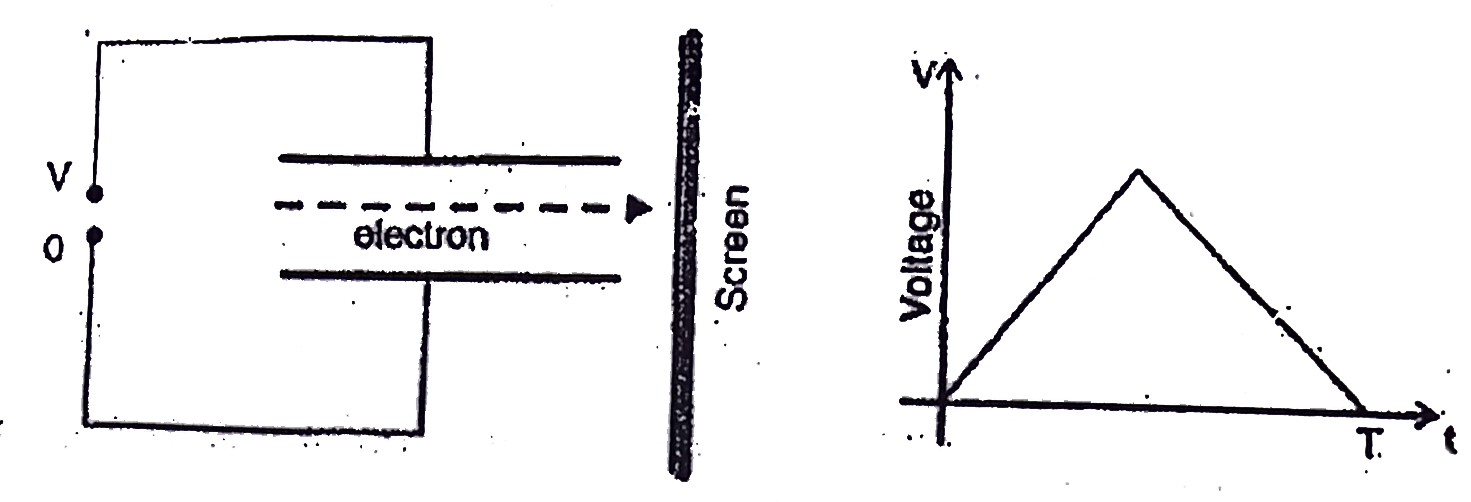
1. deflected up
2. deflected down
3. deflected up then down
4. deflected down then up
The figure shows some of the equipotential surfaces. Magnitude and direction of the electric field is given by

1. 200 V/m, making an angle with the x-axis
2. 100 V/m, pointing towards the negative x-axis
3. 200 V/m, making an angle with the x-axis
4. 100 V/m, making an angle with the x-axis
In a certain charge distribution, all points having zero potential can be joined by a circle \(S.\) The points inside \(S\) have positive potential, and points outside \(S\) have a negative potential. A positive charge, which is free to move, is placed inside \(S.\) What is the correct statement about \(S\):
| 1. | It will remain in equilibrium |
| 2. | It can move inside \(S,\) but it cannot cross \(S\) |
| 3. | It must cross \(S\) at some time |
| 4. | It may move, but will ultimately return to its starting point |
On rotating a point charge having a charge \(q\) around a charge \(Q\) in a circle of radius \(r,\) the work done will be:
| 1. | \(q \times2 \pi r\) | 2. | \(q \times2 \pi Q \over r\) |
| 3. | zero | 4. | \(Q \over 2\varepsilon_0r\) |
| 1. | The electric potential at the surface of the cube is zero. |
| 2. | The electric potential within the cube is zero. |
| 3. | The electric field is normal to the surface of the cube. |
| 4. | The electric field varies within the cube. |
An electric dipole of moment \(\vec {p} \) is lying along a uniform electric field \(\vec{E}.\) The work done in rotating the dipole by \(90^{\circ}\) is:
1. \(\sqrt{2}pE\)
2. \(\dfrac{pE}{2}\)
3. \(2pE\)
4. \(pE\)
