Biology 1 - Section A
1. Chrysophytes:
| I. |
include diatoms and desmids |
| II. |
are found only in marine water |
| III. |
are planktonic |
1. Only I and II are correct
2. Only I and III are correct
3. Only II and III are correct
4. I, II and III are correct
2. Icthyophis is a/an:
| 1. Tunicate chordate |
2. Flightless bird |
| 3. Limbless amphibian |
4. Egg-laying mammal |
3. Regarding reproduction in Cyclostomes:
| I: |
They are marine but migrate for spawning to fresh water. |
| II: |
After spawning, within a few days, they die. |
| III: |
Their larvae, after metamorphosis, return to the ocean. |
| 1. |
Only II is correct |
| 2. |
Only I and II are correct |
| 3. |
Only II and III are correct |
| 4. |
I, II and III are correct |
4. Given below is a schematic representation of the events in the life cycle of
Rhizopus. Find the correct match for A-D:

|
A |
B |
C |
D |
| 1. |
Plasmogamy |
Karyogamy |
Meiosis |
Sporangia |
| 2. |
Karyogamy |
Plasmogamy |
Meiosis |
Sporangia |
| 3. |
Plasmogamy |
Karyogamy |
Mitosis |
Conidiophores |
| 4. |
Karyogamy |
Plasmogamy |
Mitosis |
Conidiophores |
5. Consider the following statements:
| I: |
Pteridophytes are the first terrestrial plants to possess vascular bundles. |
| II: |
Main plant body in pteridophytes is sporophyte which is differentiated into true stem and leaves. |
| III: |
Genera like Selaginella and Salvinia are heterosporous. |
Which of the above statements are true?
| 1. |
I and II only |
2. |
I and III only |
| 3. |
II and III only |
4. |
I, II and III |
6. In brown algae:
| I. |
Asexual reproduction is by biflagellate zoospores that are pear shaped and have two unequal and laterally attached flagella. |
| II. |
The gametes are pyriform [pear shaped] and bear two laterally attached flagella. |
1. Both
I and
II are incorrect
2. Only
I is incorrect
3. Only
I is correct
4. Both
I and
II are correct
7. Which of the following does not relate to heterotrophic bacteria?
| 1. |
They are important decomposers. |
| 2. |
They are helpful in making curd from milk, production of antibiotics and fixing nitrogen in legume roots. |
| 3. |
Some are pathogens causing damage to human beings, crops, farm animals and pets. |
| 4. |
Almost all help in recycling nutrients like nitrogen, phosphorus, iron and sulphur. |
8. The given pattern of life cycle will be seen in:

| 1. Spirogyra |
2. Fucus |
| 3. Ectocarpus |
4. Polysiphonia |
9. Triploblastic organization, bilateral symmetry but lack of coelom will be seen in:
| 1. |
Planaria |
2. |
Pheretima |
| 3. |
Periplaneta |
4. |
Pinctada |
10. What would be true for an animal that exhibits the kind of body symmetry shown in the given diagram?

| I: |
This is seen in sponges, cnidarians, ctenophores and larval echinoderms. |
| II: |
This type of body symmetry is generally seen in animals which move actively in their environment. |
| 1. |
Only I |
2. |
Only II |
| 3. |
Both I and II |
4. |
Neither I nor II |
11. The Indian Botanical Garden and the National Botanical Research Institute are located respectively at:
| 1. Pune and Howrah |
2. Howrah and Lucknow |
| 3. Darjeeling and Lucknow |
4. Simla and Dehradun |
12. Mark true (T) or false (F) for the given statements:
| Statement I: |
Tap root of sweet potato and adventitious roots of carrot, turnip get swollen and store food. |
| Statement II: |
Prop roots are hanging and supporting structures in a banyan tree. |
| Statement III: |
Stilt root arising from the uppermost nodes in stems of maize and sugarcane are also supporting roots. |
| Statement IV: |
Pneumatophores help plants like Rhizophora growing in swampy areas to get oxygen for respiration. |
|
I |
II |
III |
IV |
| 1. |
T |
T |
F |
F |
| 2. |
F |
T |
F |
T |
| 3. |
T |
F |
T |
F |
| 4. |
F |
F |
T |
T |
13. Methanogens are commonly present in:
1. Alimentary canal of the lower invertebrates
2. Symbiotic relationships with xerophytic plants
3. Gut of ruminant animals
4. Close associations with corals
14. Bacteriophages are:
| 1. |
Bacteria infecting ss RNA viruses |
| 2. |
Bacteria infecting ds RNA viruses |
| 3. |
Viruses that infect bacteria and generally have ds DNA |
| 4. |
Viruses that infect bacteria and generally have ds RNA |
15. Which of the following regarding Cycas is incorrect?
| 1. |
Pinnate leaves persist for a few years |
| 2. |
Male and female cones are born on different plants |
| 3. |
Coralloid roots are in association with cynobacteria |
| 4. |
Homosporous gymnosperm |
16. The taxonomic unit ‘Phylum’ in the classification of animals is equivalent to which hierarchical level in classification of plants?
| 1. |
Class |
2. |
Order |
| 3. |
Division |
4. |
Family |
17. The number of correct statements regarding hemichordates from the given is:
| I: |
A stomochord is present in the collar region |
| II: |
Circulation is of open type |
| III: |
Excretory organ is proboscis gland |
| IV: |
Development is indirect |
Biology 1 - Section B
18. Identify the correct statements amongst the following:
| I: |
When a shoot tip transforms into a flower, it is always solitary |
| II: |
In racemose inflorescence, the main axis continues to grow and flowers are borne in basipetal order |
| III: |
In cymose inflorescence, the main axis terminates in a flower and flowers are borne in basipetal order |
| 1. |
Only I |
2. |
Only I and II |
| 3. |
Only I and III |
4. |
Only II and III |
19. All the following statements regarding the anatomy of a typical dicotyledonous root are correct except:
| 1. |
Many cells of the epiblema protrude in the form of unicellular root hairs. |
| 2. |
The innermost layer of the cortex is called as the endodermis. |
| 3. |
Pericycle is made up of collenchymatous cells. |
| 4. |
Parenchymatous conjunctive tissue lies between the xylem and phloem. |
20. If the fruit is formed without the fertilization of ovary, it is called as:
| 1. |
Parthenogenetic |
2. |
Parthenocarpic |
| 3. |
Aggregate |
4. |
False |
21. The term ‘peripheral endosperm’ in monocotyledonous seeds normally refers to:
| 1. |
Epicarp |
2. |
Pericarp |
| 3. |
Aleurone layer |
4. |
Starchy endosperm |
22. The floral features shown in the given figure characterizes the members of Family:

| 1. Fabaceae |
2. Solanaceae |
| 3. Liliaceae |
4. Brassicaceae |
23. The meristem that helps grasses regenerate parts removed by the grazing herbivores is the:
| 1. |
Shoot apical meristem |
2. |
Root apical meristem |
| 3. |
Intercalary meristem |
4. |
Lateral meristem |
24. The nucleus of companion cells controls the functions of:
1. Sieve cells
2. Sieve tubes
3. Albuminous cells
4. Phloem parenchyma
25. How many of the plants given in the box have actinomorphic flowers?
| Mustard, Gulmohur, Canna, Cassia, Datura, Belladonna, Petunia, Indigofera, Tulip, Asparagus, Bean |
Biology 2 - Section A
26. The cells in areolar loose connective tissue that can secrete histamine are:
| 1. |
Fibroblasts |
2. |
Macrophages |
| 3. |
Mast cells |
4. |
Basophils |
27. Consider the given two statements:
| Statement-I: |
Chloroplasts are considered endosymbiotic Cyanobacteria. |
| Statement-II: |
Cyanobacteria consist of free-living photosynthetic bacteria. |
1. Both I and II are correct and II explains I
2. Both I and II are correct but II does not explain I
3. I is correct and II is incorrect
4. Both I and II are incorrect
28. The measure of fluidity of a cell membrane is:
| 1. |
the ability of proteins to flip-flop between the two layers of phospholipids |
| 2. |
the ability of proteins to move laterally within the membrane |
| 3. |
the ability of lipids to flip-flop between the two layers of phospholipids |
| 4. |
the ability of lipids to move laterally within the membrane |
29. Cell theory, as understood today, is:
| I: |
All living organisms are composed of cells and products of cells |
| II: |
Cells of living organisms may or may not have cell walls |
| III: |
All cells arise from pre-existing cells |
| 1. |
Only I and II |
2. |
Only I and III |
| 3. |
Only II and III |
4. |
I, II and III |
30. Consider the given two statements:
| I: |
The vision in cockroach can be best described as a mosaic vision. |
| II: |
This is a nocturnal vision with more sensitivity but less resolution. |
1. Both I and II are correct and II explains I
2. Both I and II are correct but II does not explain I
3. Both I and II are incorrect
4. II is incorrect and I is correct
31. In male cockroaches, the genital pouch is bounded by:
| 1. |
9th and 10th terga dorsally and 10th sternum ventrally |
| 2. |
9th tergum dorsally and 9th and 10th sterna ventrally |
| 3. |
9th and 10th terga dorsally and 9th sternum ventrally |
| 4. |
9th and 10th terga dorsally and 9th and 10th sterna ventrally |
32. Centrosome:
| 1. |
is a non- membrane bound organelle found in all cells which helps in cell division |
| 2. |
is a non- membrane bound organelle found in plant cells which helps in cell division |
| 3. |
is a non- membrane bound organelle found in animal cells which helps in DNA replication |
| 4. |
is a non- membrane bound organelle found in animal cells which helps in cell division |
33. The diagram shows comparison of size of eukaryotic cell with other organisms. What would be the correct size for I, II, III and IV?

| I: |
10-20 µm |
| II: |
0.2-2.0 µm |
| III: |
About 10 µm |
| IV: |
1-2 µm |
| 1. |
Only I and III |
2. |
Only I and IV |
| 3. |
Only II and III |
4. |
Only I, II and IV |
34. A single membrane, tonoplast, binds the:
| 1. Inclusion bodies |
2. Polysomes |
| 3. Vacuoles |
4. Lysosomes |
35. Study the given diagram and select the correct statements regarding the parts labels I, II and III.

| A: |
I are ribosomes and found only in eukaryotic cells. |
| B: |
II is Rough Endoplasmic Reticulum frequently observed in cells actively involved in protein synthesis and secretion. |
| C: |
III is Smooth Endoplasmic Reticulum which is a major site for synthesis of lipids. |
| 1. |
Only A and B |
2. |
Only A and C |
| 3. |
Only B and C |
4. |
A, B and C |
36. Match each item in Column I with only one item in Column II and select the correct match from the codes given:
Column I
[Component] |
Column II
[% of the total cellular mass] |
| A. Protein |
P. 2 |
| B. Carbohydrates |
Q. 1 |
| C. Lipids |
R. 5-7 |
| D. Nucleic acids |
S. 3 |
|
T. 10-15 |
|
U. 70-90 |
Codes:
|
A |
B |
C |
D |
| 1. |
U |
P |
R |
Q |
| 2. |
T |
S |
P |
R |
| 3. |
T |
P |
S |
R |
| 4. |
P |
Q |
R |
S |
37. Consider the given two statements:
| Statement I: |
Lipids are a part of acid insoluble fraction or the macromolecular fraction during chemical analysis of a cell. |
| Statement II: |
Lipids have a molecular weight running in thousands of Dalton. |
| 1. |
Both Statement I and Statement II are correct and Statement II correctly explains Statement I |
| 2. |
Both Statement I and Statement II are correct but Statement II does not correctly explain Statement I |
| 3. |
Statement I is correct but Statement II is incorrect |
| 4. |
Statement I is incorrect but Statement II is correct |
38. Consider the given two statements:
| I. |
In secondary growth in dicot stems, the amount of secondary phloem produced is more than secondary xylem |
| II. |
The cambium is generally more active on the outer side than the inner |
| 1. |
Both I and II are true and II explains I |
| 2. |
Both I and II are true but II does not explain I |
| 3. |
I is true but II is false |
| 4. |
Both I and II are false |
39. Consider the given two statements:
| I: |
Living organisms defy the Second Law of Thermodynamics. |
| II: |
They are able to increase their level of organization. |
1. Both I and II are correct and II explains I
2. Both I and II are correct but II does not explain I
3. I is correct and II is incorrect
4. Both I and II are incorrect
40. Communication junctions found at some fusion points that allow the cardiac muscle cells to contract as a unit are called as:
1. Intercalated discs
2. Sarcolemma
3. Nodes of Ranvier
4. Motor end plates
41. Identify the given biomolecule:

| 1. |
Thymine |
2. |
Thymosine |
| 3. |
Thymidylic acid |
4. |
Cytidylic acid |
42. Consider the following two statements:
| I: |
Secondary constrictions can be used as markers to identify the particular SAT chromosomes. |
| II: |
The secondary constrictions are always constant in their positions. |
1. Both I and II are correct and II explains I
2. Both I and II are correct but II does not explain I
3. I is correct and II is incorrect
4. Both I and II are incorrect
Biology 2 - Section B
43. Chitin, a complex polysaccharide, is found in:
| 1. |
Plant cell wall |
| 2. |
The exoskeleton of arthropods and cell walls of most fungi |
| 3. |
Bacterial cell wall |
| 4. |
Cartilage and other connective tissues |
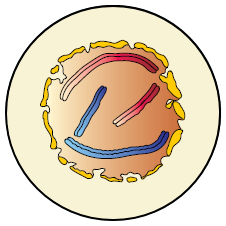
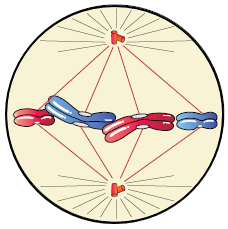
44. Which of the following cells is in transition to metaphase?
45. If an active-site directed inhibitor is present in the medium, the curve that will represent the progress of the chemical reaction will be shown by the letter:

46. Most of the coenzymes contain:
| 1. Metal ions |
2. FMN and FAD |
| 3. Ribonucleoproteins |
4. Vitamins |
47. The true macromolecular fraction of any living tissue or cell includes all the following biomolecules except:
| 1. |
Nucleic acids |
2. |
Polysaccharides |
| 3. |
Lipids |
4. |
Proteins |
48. Cells at the end of prophase, when viewed under the microscope, show:
1. Nuclear envelope
2. Nucleolus
3. Mitochondria
4. Endoplasmic reticulum
49. The cells in the quiescent stage [G0] phase of the cell cycle:
| 1. |
exit from the S phase |
| 2. |
continue the events of cell cycle and complete the division |
| 3. |
are metabolically active
|
| 4. |
cannot ever proliferate |
50. Which stage of meiosis is shown in the diagram given below?

| 1. |
Metaphase I |
2. |
Metaphase II |
| 3. |
Anaphase I |
4. |
Anaphase II |
*If above link doesn't work, please go to test link from where you got the pdf and fill OMR from there
CLICK HERE to get FREE ACCESS for 2 days of ANY NEETprep course
 Test 13 (Class 11) - Type Recall (Old NCERT)Contact Number: 8527521718