 Systems of Particles and Rotational Motion Part 2: Torque, Angular Momentum and Rolling MotionContact Number: 8527521718Systems of Particles and Rotational Motion Part 2: Torque, Angular Momentum and Rolling MotionContact Number: 8527521718
A thin circular ring of mass M and radius r is rotating about its axis with a constant angular velocity . Four objects, each of mass m are attached gently to the opposite ends of the diameter of the ring. The ring rotates now with an angular velocity:
1.
2.
3.
4.
ABC is an equilateral triangle with O as its centre. F1, F2 and F3 represent three forces acting along the sides AB, BC and AC respectively. If the total torque about O is zero then the magnitude of F3 is:
1.
2.
3.
4.
A particle of mass m moves along the line y = x with speed v. The magnitude of angular momentum about the point (a, 0) is:
1. mva
2. 2mva
3. mva
4.
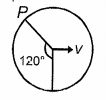
A disc rolls on the ground without slipping. The velocity of the centre of mass is v. The speed of the particle P at circumference (vp) is:
1. v
2.
3. 2v
4.
The ratio of total energy to the rotational kinetic energy of rolling solid sphere is:
1.
2.
3.
4.
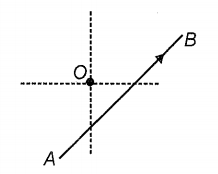
A particle is moving along path AB. The angular momentum of the particle about the origin:
1. remains the same.
2. first increases then decreases.
3. first decreases then increases.
4. is zero.
A projectile of mass 1 kg is projected with an initial velocity of 20 m/s at angle 60 with horizontal. Angular momentum of the projectile about the point of projection when it is at maximum height is:
1.
2.
3.
4.
If a constant torque of 500 Nm turns a wheel of the moment of inertia 100 kgm2 about an axis passing through its centre, then the gain in angular velocity in 2 sec is:
1. 10 rad/s
2. 5 rad/s
3. 20 rad/s
4. 25 rad/s
A solid sphere is set into pure rolling on an inclined plane. Speed of centre C when the sphere reaches the bottom will be: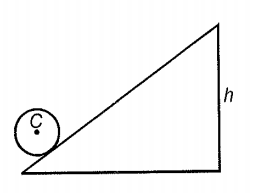
1.
2.
3.
4.
A tangential force F acts at the top of a thin spherical shell of mass m and radius R. The acceleration of the shell, if it rolls without slipping is: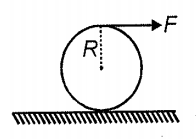
1.
2.
3.
4.
The value of \(M\), as shown, for which the rod will be in equilibrium is:
| 1. | \(1\) kg | 2. | \(2\) kg |
| 3. | \(4\) kg | 4. | \(6\) kg |
The minimum coefficient of friction for a solid sphere to roll without slipping on an inclined plane of inclination 45 is:
1.
2.
3.
4.
A disc of radius R is moving without slipping with a linear velocity v. If vP and vQ are velocities of points P and Q respectively as shown in the figure, then the ratio is: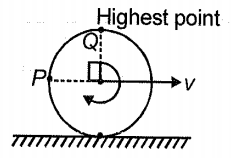
1. 2
2.
3.
4. 1
A meter scale is under the action of three forces as shown in the figure. The net torque about the centre of the scale is: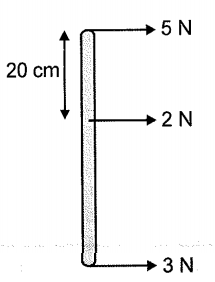
1. 1.6 Nm
2. 2.8 Nm
3. 3.2 Nm
4. 2.2 Nm
A uniform rod of mass m and length l is held initially vertical as shown in the figure. If end A of the rod is released at t = 0 and the rod does not slip at B, then the angular velocity of the rod about end B when it hits the ground is: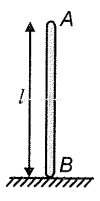
1.
2.
3.
4.
The torque about the point of projection of a projectile when the velocity of the particle becomes perpendicular to the direction of initial velocity is
1.
2.
3.
4.
A rod is falling down with constant velocity v0 as shown. It comes in contact with hinge A and rotates about A. Angular velocity of the rod just after the moment when it comes in contact with hinge A: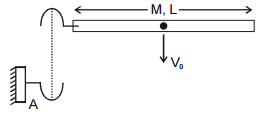
1.
2.
3.
4.
A small ball strikes a stationary uniform rod, which is free to rotate, in gravity-free space. The ball does not stick to the rod. The rod will rotate about:
1. its centre of mass.
2. the centre of mass of 'rod plus ball'.
3. the point of impact of the ball on the rod.
4. the point about which the moment of inertia of the 'rod plus ball' is minimum.
A solid cylinder of mass 2 kg and radius 4 cm is rotating about its axis at the rate of 3 rpm. The torque required to stop after 2 revolutions is:
1.
2.
3.
4.

