 Organic Chemistry: Some Basic Principles & Techniques: Reaction MechanismContact Number: 8527521718Organic Chemistry: Some Basic Principles & Techniques: Reaction MechanismContact Number: 8527521718
(CH3)3CCI + (CH3)3C K+ → Product
1. SN Product will be more
2. E2 Product will be more
3. Both will be the same
4. None of the above
The correct statement regarding electrophile is
| 1. | Electrophile is a negatively charge species and can form a bond by accepting a pair of electrons from a nucleophile |
| 2. | Electrophile is a negatively charged species and can form a bond by accepting a pair of electrons from another electrophile |
| 3. | Electrophile can be either neutral or positively charged species and can form a bond by accepting a pair of electrons from a nucleophile |
| 4. | Electrophiles are generally neutral species and can form a bond by accepting a pair of electrons from a nucleophile |
Which of the following is not correct for a nucleophile?
1. Nucleophile is a Lewis acid
2. Ammonia is a nucleophile
3. Nucleophiles attack low electron density sites
4. Nucleophiles are not electron seeking
A compound among the following that does not undergo Friedel-Craft's reaction easily is:
1. Cumene
2. Xylene
3. Nitrobenzene
4. Toluene
Arrange the following compounds in increasing order of their reactivity toward electrophilic aromatic substitution reactions.
| 1. | III < I < II | 2. | III < II < I |
| 3. | II < I < III | 4. | II < III < I |
3-Phenylpropene on reaction with HBr gives (as a major product)-
1.
2.
3.
4.
1. E1
2. E2
3.
4. elimination
For reaction, the preferred solvent will be:
| 1. | Water | 2. | Benzene |
| 3. | Ether | 4. | Toluene |
The main product of the following reaction will be-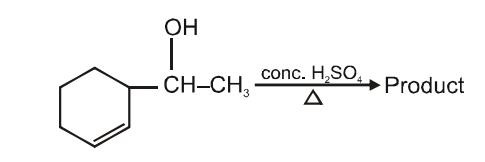
| 1. |  |
2. |  |
| 3. |  |
4. |  |
The reaction of propene with HOCl proceeds via the addition of:
| 1. | H+ in the first step | 2. | Cl+ in the first step |
| 3. | OH- in the first step | 4. | Cl+ and OH- in a single step |
What results from the reaction of 2-bromopentane with alcoholic KOH?
| 1. | Cis-2-Pentene | 2. | Trans-2-Pentene |
| 3. | 1-Pentene | 4. | None of the above |
What is the major product formed when toluene is refluxed with Br₂ in the presence of light?
1. p-Bromotoluene.
2. Benzyl bromide.
3. o-Bromotoluene.
4. Mixture of o- and p-bromotoluene.
The major product(s) in the below reaction is-
\(H_{3} C - CH = CH_{2} \xrightarrow[{\left(\right. Ph - CO - O \left.\right)_{2}}]{HBr} S\)
1. \(\underset{1 - Bromopropane}{H_{3} C - CH_{2} - CH_{2} Br}\)
2. \(\underset{2 - Bromopropane}{CH_{3} - \underset{Br}{\underset{\left|\right.}{CH}} - CH_{3}}\)
3. \(\underset{Propene}{CH_{3} - CH = CH_{2}}\)
4. None of the above
The type of radicals that can be formed as intermediates during monochlorination of 2-methylpropane is-
1. Primary and tertiary radicals
2. Two types of primary radicals
3. Primary and secondary radicals
4. Two types of tertiary radical
The mechanism & intermediate involved in the above reaction are:
1. Aromatic electrophilic substitution & carbocation
2. Aromatic Nucleophilic substitution & carbanion
3. Aromatic free radical substitution & Free radical
4. Carbene based substitution reaction & Carbene
The correct representation involving heterolytic fission of among the following is:
| 1. |  |
| 2. |  |
| 3. |  |
| 4. |  |
The addition of HCl to an alkene proceeds in two steps. The first step is the attack of H+ ion on the double bond portion. The same can be shown as-
| 1. |  |
2. |  |
| 3. |  |
4. | All of these are possible |
Consider the reactions:
| (i) | \(\small{{(CH_3)}_2CHCH_2Br\ \xrightarrow[]{C_2H_5OH}{(CH_3)}_2CHCH_2OC_2H_5 + HBr}\) |
| (ii) | \(\small{{(CH_3)}_2CHCH_2Br\ \xrightarrow[]{C_2H_5O^-}{(CH_3)}_2CHCH_2OC_2H_5 + Br^-}\) |
The mechanisms of reactions (i) and (ii) are, respectively:
What products are formed when the following compound is treated with Br2 in the presence of FeBr3?

| 1. |  |
2. |  |
| 3. |  |
4. |  |
Chlorine atom can be classified as:
| 1. | Carbocation | 2. | Nucleophile |
| 3. | Electrophile | 4. | Carbanion |
