 Electromagnetic Induction Part 1: Magnetic Flux, Faraday law, Lenz law, Motional EMFContact Number: 8527521718Electromagnetic Induction Part 1: Magnetic Flux, Faraday law, Lenz law, Motional EMFContact Number: 8527521718
A semicircular wire of radius R is rotated with constant angular velocity about an axis passing through one end and perpendicular to the plane of the wire.
There is a uniform magnetic field of strength B. The induced emf between the ends is?
1.
2.
3. is variable
4. none of these
| 1. | \(2.5 \times 10^{-3} ~\text V\) | 2. | \(1.5 \times 10^{-4} ~\text V\) |
| 3. | \(2.5 \times 10^{-4}~\text V\) | 4. | \(1.5 \times 10^{-3} ~\text V\) |
Figure shows a metal rod PQ resting on the smooth rails AB and positioned between the poles of a permanent magnet. The rails, the rod, and the magnetic field are in three mutually perpendicular directions. A galvanometer G connects the rails through a switch K. Length of the rod = 15 cm, B = 0.50 T, resistance of the closed-loop containing the rod = 9.0 mΩ. Assume the field to be uniform.
What is the magnitude of the induced emf if we will keep the K open and the rod is moved with the speed of 12 cm/s in the direction shown in the figure?
1. 9.8 mV
2. 4.9 mV
3. 0.9 mV
4. 9.0 mV
A magnet is brought near a coil in two ways (i) rapidly (ii) slowly. The induced charge will be:
1. More in case (i)
2. More in case (ii)
3. Equal in both the cases
4. More or less according to the radius of the coil
An emf can be induced in a stationary coil if it is kept in?
1. Stationary uniform magnetic field
2. Stationary non-uniform magnetic field
3. Time-varying magnetic field
4. Not possible
The induced e.m.f. does not depend on?
1. The number of turns the coil
2. The rate of change of magnetic flux
3. Time of rotation
4. The resistance of the circuit
A circular loop of flexible conducting material is kept in a magnetic field directed perpendicularly into its plane. By holding the loop at diametrically opposite points it is suddenly stretched outwards, then;
1. No current is induced in the loop
2. Anti-clockwise current is induced
3. Clockwise current is induced
4. Only e.m.f. is induced
The magnetic flux through a coil varies with time \(t\) as shown in the diagram. Which graph best represents the variation of the emf \(E\) induced in the coil with time \(t\)?

| 1. |  |
2. |  |
| 3. |  |
4. |  |
A coil having 500 square loops each of side 10 cm is placed with its plane perpendicular to a magnetic field which increases at a rate of 1.0 tesla/s. The induce e.m.f. (in volts) is:
1. 0.5
2. 0.1
3. 1.0
4. 5.0
A loop of irregular shape made of flexible conducting wire carrying clockwise current is placed in uniform inward magnetic field, such that its plane is perpendicular to the field. Then the loop
1. Experiences force
2. Develops induced current for a short time
3. Changes to circular loop
4. All of these
A flat coil of 500 turns, each of area 50 cm2, rotates in a uniform magnetic field of 0.14 Wb/m2 about an axis normal to the field at an angular speed of 150 rad/s. The coil has a resistance of . The induced e.m.f. is applied to an external resistance of . The peak current through the resistance is?
1. 1.5 A
2. 2.5 A
3. 3.5 A
4. 4.5 A
The physical quantity, which is conserved on the basis of Lenz's Law is?
1. Charge
2. Momentum
3. Mass
4. Energy
An aeroplane is flying horizontally with a velocity of 360 km/h. The distance between the tips of the wings of aeroplane is 25 m. The vertical component of earth's magnetic field is . The induced e.m.f. is?
1. 1 V
2. 100 V
3. 1 kV
4. Zero
A metallic ring with a cut is held horizontally and a magnet is allowed to fall vertically through the ring, then the acceleration of this magnet is?
1. Equal to g
2. More than g
3. Less than g
4. Sometimes less and sometimes more than g
When a conducting wire \(XY\) is moved towards the right, a current flows in the anti-clockwise direction. Direction of magnetic field at point \(O\) is:
| 1. | parallel to the motion of wire. |
| 2. | along with \(XY\). |
| 3. | perpendicular outside the paper. |
| 4. | perpendicular inside the paper. |
A copper rod of length l is rotated about one end perpendicular to the uniform magnetic field B with constant angular velocity . The induced e.m.f. between its two ends is?
1.
2.
3.
4.
A loop of irregular shape of conducting wire PQRS (as shown in figure) placed in a uniform magnetic field perpendicular to the plane of the paper changes into a circular shape. The direction of induced current will be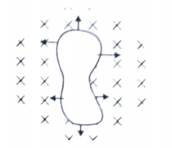
1. Clockwise
2. Anti-clockwise
3. No current
4. None of these
A coil having number of turns N and area A is rotated in a uniform magnetic field B with angular velocity about its diameter. Maximum e.m.f. induced in it is given by
1.
2.
3.
4.
Two identical conductors \(P\) and \(Q\) are placed on two frictionless (conducting) rails \(R\) and \(S\) in a uniform magnetic field directed into the plane. If \(P\) is moved in the direction as shown in the figure with a constant speed, then rod \(Q\):

| 1. | will be attracted toward \(P\). |
| 2. | will be repelled away from \(P\). |
| 3. | will remain stationary. |
| 4. | maybe repelled or attracted towards \(P\). |

| 1. | From \(a\) to \(b\) and from \(c\) to \(d\) |
| 2. | From \(a\) to \(b\) and from \(f\) to \(e\) |
| 3. | From \(b\) to \(a\) and from \(d\) to \(c\) |
| 4. | From \(b\) to \(a\) and from \(e\) to \(f\) |
