 Moving Charges and Magnetism Part 1: Magnetic FieldContact Number: 8527521718Moving Charges and Magnetism Part 1: Magnetic FieldContact Number: 8527521718
The variation of the magnetic field along the axis of a solenoid is graphically represented by:
(\(O\) is the centre with \(I,I'\) as the extremities of the solenoid along the axis)
| 1. |  |
2. |  |
| 3. |  |
4. |  |
A ring of radius \(R\) carries a linear charge density \(\lambda\). It is rotating with angular speed \(\omega\) about an axis passing through the centre and perpendicular to the plane. What is the magnetic field at its centre?
| 1. | \(\dfrac{3 \mu_{0} \lambda \omega}{2}\) | 2. | \(\dfrac{\mu_{0} \lambda \omega}{2}\) |
| 3. | \(\dfrac{\mu_{0} \lambda \omega}{\pi}\) | 4. | \(\mu_{0} \lambda \omega\) |
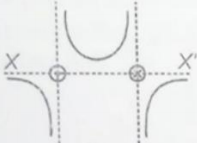
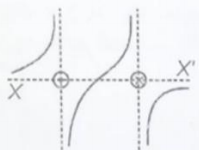
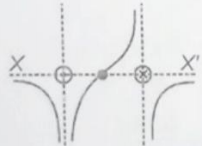
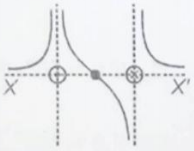
Two long parallel wires are at a distance d apart. They carry steady equal currents out of the plane of the paper in the opposite direction as shown in the figure. The variation of the magnetic field B along the line XX' is given by
1. 
2. 
3. 
4. 
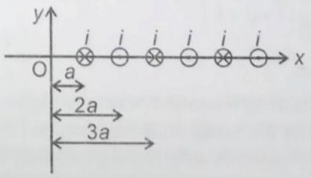
Wires of infinite length each carrying a current i are placed on the x-axis respectively along x=a, x=2a, x=3a and so on, as shown in the figure. The magnetic field at the origin is?
1. Zero
2.
3.
4.
Circular regions (1) and (2) have current densities J and -J respectively, such that their region of intersection carries no current. Magnetic field in their region of intersection is?
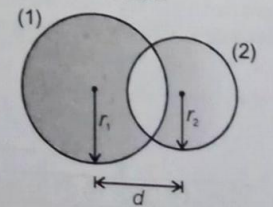
1. Uniform, proportional to -d
2. Uniform, proportional to d
3. Non-uniform
4. Zero
A loop carrying current l has the shape of a regular polygon of n side. If R is the distance from the center to any vertex, then the magnitude of the magnetic induction vector B at the center of the loop is?
1.
2.
3.
4.
The resistance R = V/I where V = (100 ± 5)V and I = (10 ± 0.2)A. The percentage error in R is:
1.
2.
3.
4.
Two infinitely long parallel wires carry currents of magnitude and are at a distance 4 cm apart. The magnitude of the net magnetic field is found to reach a non zero minimum value between the two wires and 1 cm away from the first wire. The ratio of the two currents and their mutual direction is?
1.
2.
3.
4.
A long straight wire of radius \(R\) carries a uniformly distributed current \(i.\) The variation of magnetic field \(B\) from the axis of the wire is correctly presented by the graph?
| 1. |  |
2. |  |
| 3. |  |
4. |  |
Four thin straight long wires are all parallel to Z-axis. They pass through the points A (3, 0, 0), B (0, 3, 0), C (-3, 0, 0) and D(0, -3, 0). They all carry currents in direction of magnitudes 0.3 A, 0.6 A, 0.3 A, and 0.3 A respectively. The magnitude of the magnetic field at the origin O due to
1. Wires at A and C is zero
2. Wires at A and B is
3. Wires at A and D is
4. All wires is 2 x
A current-carrying loop is turned into a coil having n identical concentric turns. Magnetic field at the center becomes x times its initial value, then x = ?
1. n
2.
3. 2n
4.
Current is flowing in a thick metal rod. The magnetic field is associated with the current will be?
1. Only inside the rod
2. Only outside the rod
3. Both inside and outside the rod
4. Neither inside nor outside the rod
The magnetic intensity near one end of a long solenoid of length L and having N turns and carrying current i is given as?
1.
2.
3.
4.
What should be current in a circular coil formed by a wire of length 31.4 cm to produce a magnetic field of ?
1. 0.8 A
2. 8 A
3. 2 A
4. 80 A
Magnetic field at the center of an infinite solenoid is\( B.\) Magnetic field at its end will be
1. \( B\)
2. \(\dfrac{B}{2}\)
3. \(2B\)
4. \(Zero\)
Two long parallel wires A and B carry current . When are in same direction the magnetic field at a point midway between the wires is . If is reversed the field becomes . The ratio is?
1. 1
2. 3
3. 4
4. 2
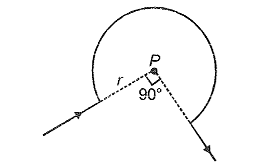
The wire shown carries a current of 40 A. If radius r= 1.57 cm, the magnetic field at point P will be?
1.
2.
3.
4.
| 1. | \(B \over 2\) | 2. | \(2B\) |
| 3. | \(B \over 4\) | 4. | \(2B \over 3\) |
Magnetic field at the centre of the orbit of an electron in H atom is B. Magnetic field at the center of the orbit is?
1.
2.
3.
4.
The magnetic field intensity at the point O of a loop with current i, whose shape is illustrated below is?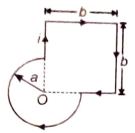
1.
2.
3.
4.